

NASA’s Lucy spacecraft revealed that a bizarre wobbling, peanut-shaped asteroid holds surprising clues about ancient water and the origins of the solar system.
Even a relatively small asteroid can have a surprisingly dramatic history. During a close flyby of the asteroid Donaldjohanson, NASA’s Lucy spacecraft discovered an oddly shaped world that wobbles through space, bears scars from an ancient collision, and even preserves evidence that liquid water briefly existed on its parent body long ago.
The asteroid formed about 155 million years ago when fragments from a violent impact slowly came back together. Since then, sunlight has steadily altered its rotation through a subtle but powerful process, leaving behind clues to its long and eventful evolution.
A timelapse video made from images taken by NASA’s Lucy spacecraft as it approached the asteroid Donaldjohanson on April 20, 2025. The L’LORRI (Lucy Long Range Reconnaissance Imager) instrument, the spacecraft’s high-resolution black-and-white imager, collected these images over two hours as the spacecraft rapidly closed in on the asteroid from an initial separation of more than 58,000 miles (93,000 km), until the spacecraft passed a mere 650 miles (1000 km) from the 5-mile (8 km) wide asteroid. Credit: NASA/Goddard/SwRI/JHU-APL
Lucy’s Close Encounter With Donaldjohanson
On April 20, 2025, Lucy flew within 650 miles of Donaldjohanson while traveling through the main asteroid belt on its way to the Jupiter Trojan asteroids. The spacecraft captured the first detailed images and scientific measurements of this previously unexplored object.
Rather than rotating around a single axis like most planets and asteroids, Donaldjohanson was found to have a much more complicated motion involving two separate rotational movements. The flyby also revealed its distinctive peanut-like shape along with numerous craters and ridges covering its surface.
The encounter served as a full-scale rehearsal before Lucy begins exploring the Trojan asteroids, starting with its flyby of Eurybates on Aug. 12, 2027. Everything aboard the spacecraft operated as planned, while scientists gained an unexpected opportunity to compare Donaldjohanson with two better-known asteroids, Bennu and Ryugu. Those two bodies have similar compositions but followed very different evolutionary paths after their formation.
The Lucy team’s initial findings were published June 18 in the journal Science.
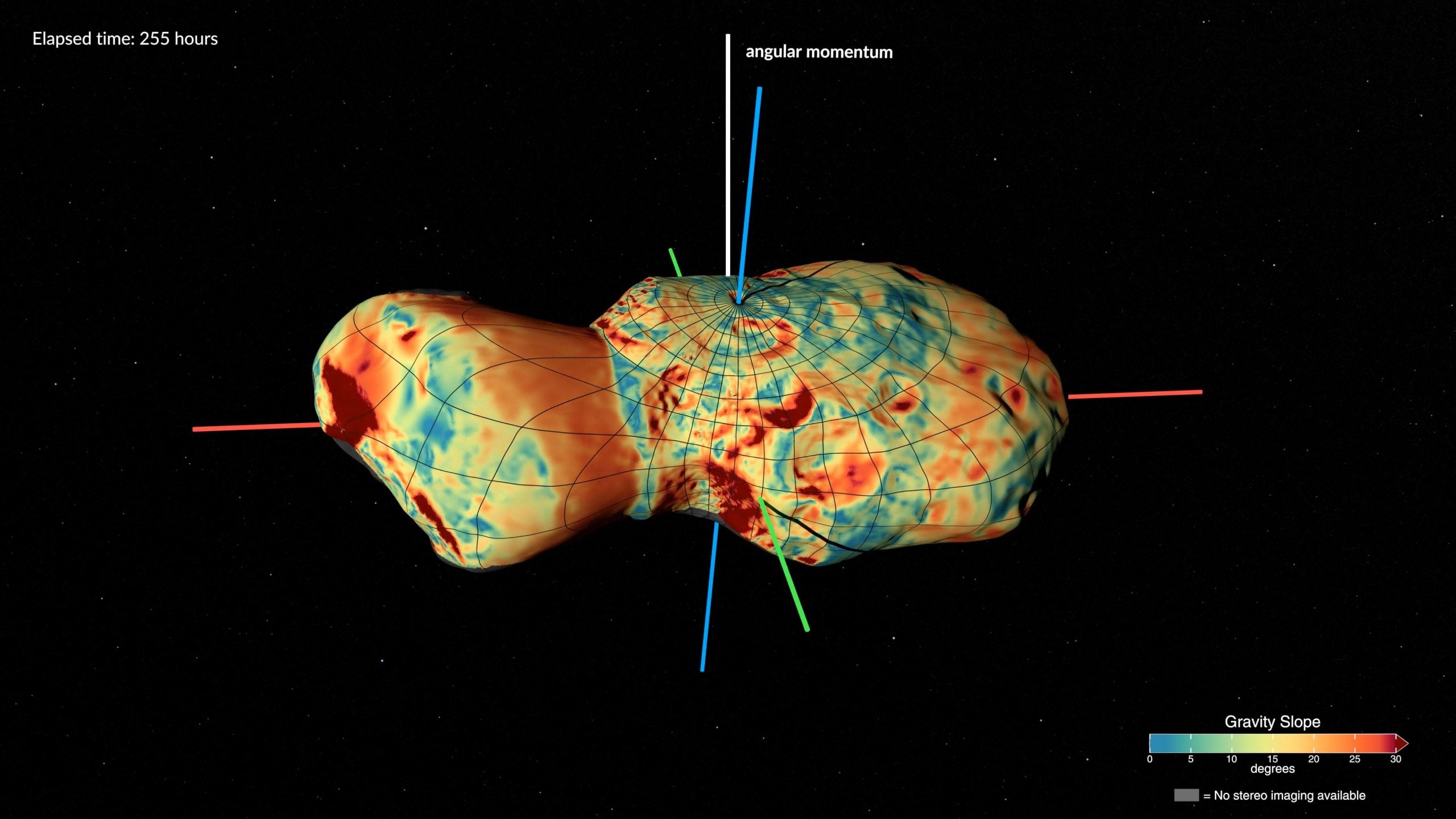
The asteroid Donaldjohanson is shown slowly rotating in a tumbling, non-principal axis motion, with its angular momentum vector and rotation axes indicated. The surface is colored by gravity slope, which measures the angle between the local surface and the direction of gravity. Higher values (warmer colors) indicate steeper terrain relative to the local gravitational pull. Regions with limited stereo image coverage have been masked out where the shape model is less well constrained. Credit: Kel Elkins/NASA’s Science Visualization Studio/DLR
A Wobbling Asteroid Unlike Most Others
Before Lucy arrived, astronomers using Earth-based telescopes noticed regular changes in the asteroid’s brightness, indicating that the elongated object completed one rotation every 10.5 Earth days.
Lucy revealed that the situation is much more complex. Instead of spinning smoothly, Donaldjohanson behaves more like a wobbling top. It rotates end over end every 10.5 days while also rocking back and forth around its long axis every 26.5 days.
How a Peanut Shape Formed
Earlier observations suggested the asteroid was elongated, but Lucy’s close-up images showed that it is actually a “bilobate” object consisting of two connected lobes separated by a narrow neck, giving it the appearance of a peanut.
Scientists believe these two lobes were once separate fragments created during an asteroid collision. Their own gravity eventually pulled them together into a single object.
Researchers estimate that Donaldjohanson originally spun at least 10 times faster than it does today. Over the past 20 million to 60 million years, its rotation gradually slowed. As the spin decreased, the balance between gravity and centrifugal force changed, allowing loose rocks and debris to slide downhill and soften the appearance of many impact craters seen in Lucy’s images.
Sunlight Slowly Changed Its Spin
The researchers believe the slowdown was caused by the YORP effect, a process driven by sunlight.
As the Sun warms different parts of an asteroid’s surface, those areas release the absorbed energy as infrared radiation. Although the force produced is extremely small, an unevenly shaped asteroid experiences a tiny twisting effect that can gradually alter its rotation over millions of years.
This same process can either slow or speed up other asteroids. Bennu, for example, now rotates once every four hours, while Ryugu spins about once every seven hours. Scientists think both of those asteroids once rotated much more slowly before the YORP effect accelerated them.
Signs of Ancient Liquid Water
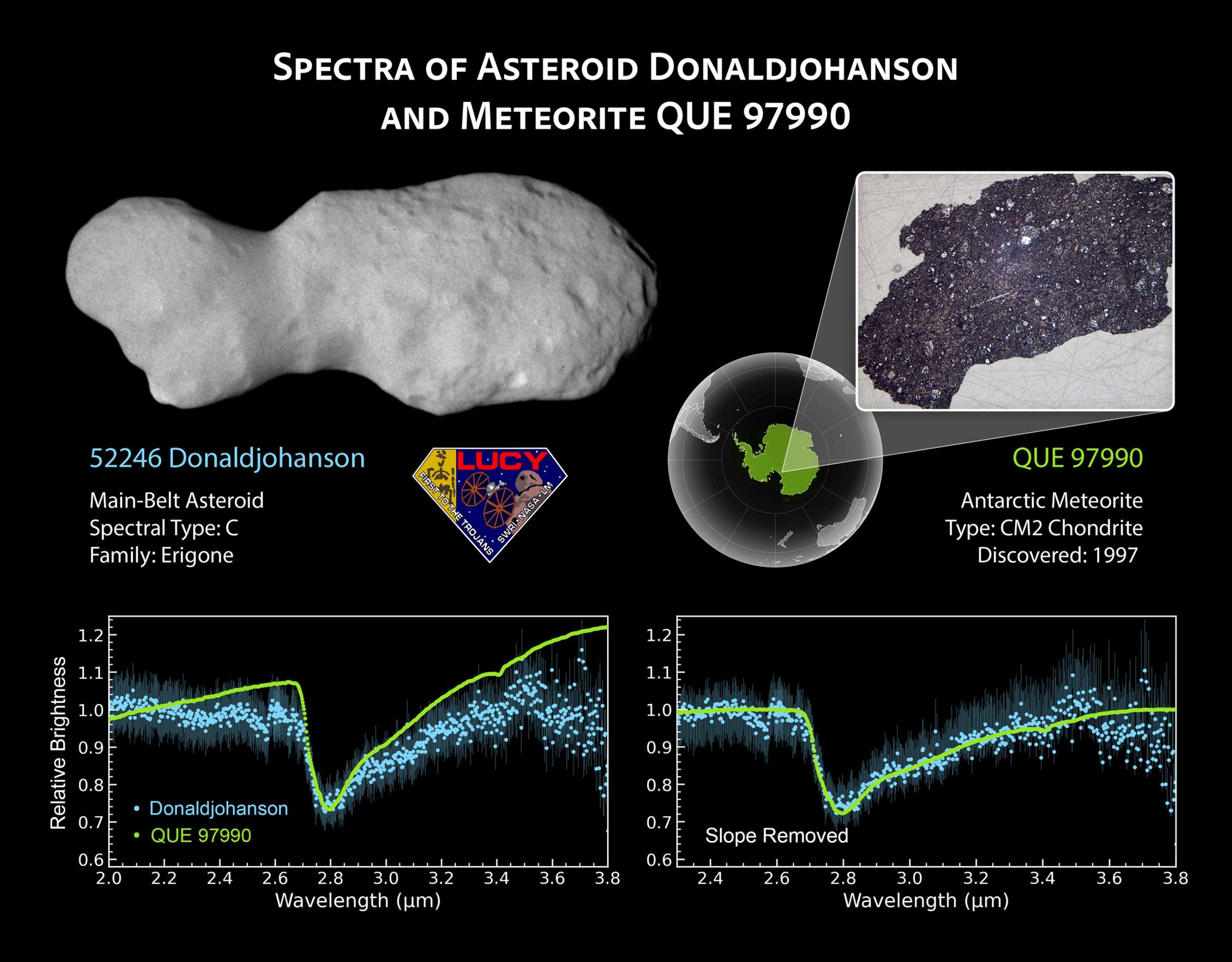
As Lucy sped past Donaldjohanson at roughly 30,000 mph, its instruments detected iron-rich clay minerals on the asteroid’s surface.
These minerals could only have formed in the presence of liquid water sometime in the distant past. However, researchers concluded that the water was present only briefly because prolonged exposure typically replaces the iron in these clays with elements such as magnesium.
That contrasts with Bennu and Ryugu, where scientists found magnesium-rich clay minerals that point to much longer periods of water exposure, possibly lasting millions of years while those asteroids were still part of larger parent bodies.
The different mineral signatures suggest that the parent asteroids may have formed at different times or in different regions of the early solar system before eventually ending up in the main asteroid belt.
Comparing Donaldjohanson With Bennu and Ryugu
Donaldjohanson is believed to be made from the remains of a larger asteroid that contained both carbon and water and was shattered in a collision within the main asteroid belt. Scientists think Bennu and Ryugu share a similar origin.
The differences, however, are just as important.
Donaldjohanson formed only about 155 million years ago, making it far younger than Bennu and Ryugu, which originated roughly 1 to 2 billion years ago. It has also stayed in the asteroid belt throughout its existence, while Bennu and Ryugu gradually migrated into orbits that periodically bring them close to Earth, making them ideal targets for sample return missions.
“It’s helpful for scientists to compare Donaldjohanson with asteroids like Bennu and Ryugu, which are seemingly similar asteroids, because every subtle difference is another clue to our origin story,” said Simone Marchi, Lucy deputy principal investigator and lead author of the study at the Boulder, Colorado, office of the Southwest Research Institute.
“Once we start learning more about the Trojans, a completely different population of space rocks with very different histories, our understanding of solar system formation is destined to be challenged,” said Marchi.
Lucy’s Mission to the Trojan Asteroids
Donaldjohanson is only a preview of Lucy’s primary mission.
Named after the famous fossilized human ancestor discovered in Ethiopia in 1974, Lucy will become the first spacecraft to explore Jupiter’s Trojan asteroids. These ancient, well-preserved objects formed during the earliest days of the solar system and may help scientists better understand how the planets formed, migrated, and eventually settled into their present orbits.
Reference: “The Lucy flyby of (52246) Donaldjohanson: A bilobed asteroid with tumbling rotation” by Simone Marchi, Harold F. Levison, Keith S. Noll, John R. Spencer, Thomas S. Statler, Olivier S. Barnouin, James F. BellIII, Edward B. Bierhaus, Richard Binzel, William F. Bottke, Daniel Britt, Michael E. Brown, Marc W. Buie, Philip R. Christensen, Neil Dello Russo, Joshua P. Emery, William M. Grundy, Victoria E. Hamilton, Carly Howett, Hannah H. Kaplan, Katherine Kretke, Tod R. Lauer, Brian H. May, Stefano Mottola, Catherine B. Olkin, Martin Pätzold, Joel Wm. Parker, Frank Preusker, Silvia Protopapa, Dennis C. Reuter, Stuart J. Robbins, Julien Salmon, Amy A. Simon, S. Alan Stern, Jessica M. Sunshine, David Vokrouhlický, Harold A. Weaver, Harrison Agrusa, Emily S. Costello, Masatoshi Hirabayashi, Fiona Nichols-Fleming, Jennifer E. C. Scully, Anne Verbiscer, Coralie Adam, John Andrews, Kevin E. Berry, Emma Birath, Rich Burns, Russell Carpenter, Mark Effertz, Kristen Francis, Jeroen Geeraert, Sheila Gray, Katie Hegedus, David Kaufmann, Brian A. Keeney, Thomas Kennedy, Jim McAdams, Matthew Montanaro, Jon Pineau, Devin Poland, Eric Sahr, Ishita Solanki, Dale Stanbridge, Brian Sutter and Michael Vincent, 18 June 2026, Science.
DOI: 10.1126/science.aec0503
Lucy is led by a principal investigator at the Boulder, Colorado, branch of Southwest Research Institute, which is headquartered in San Antonio. NASA’s Goddard Space Flight Center in Greenbelt, Maryland, oversees mission management, systems engineering, safety, and mission assurance. Lockheed Martin Space in Littleton, Colorado, built the spacecraft. Lucy is the 13th mission in NASA’s Discovery Program, which is managed by NASA’s Marshall Space Flight Center in Huntsville, Alabama, for the agency’s Science Mission Directorate in Washington.
Never miss a breakthrough: Join the SciTechDaily newsletter.
Follow us on Google and Google News.


