
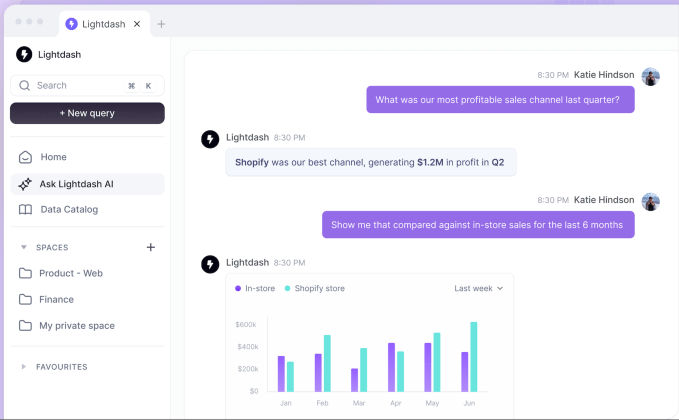
Lightdash, a business intelligence (BI) platform and open source alternative to Google’s Looker, is lifting the lid on a new product that allows companies to train “AI analysts” specific to individual teams’ use-cases, enabling anyone in a company to query aggregate business data.
To help, the 4-year-old startup also on Tuesday announced that it has raised $11 million in a Series A round of funding led by Accel.
Lightdash is built for an open source command-line-based data transformation tool called dbt (data build tool), which leans on SQL to help businesses transform raw data into structured, analysis-ready datasets. The company was known as Hubble when it graduated from Y Combinator’s (YC) S20 batch, with a focus on running tests on companies’ data warehouse to identify issues with data quality. As things transpired, these metrics were most useful baked into BI tools, which is why co-founder and CEO Hamzah Chaudhary pivoted the product and brand to Lightdash in 2021.
For context, “business intelligence” describes the process of pooling and integrating disparate data sets to unlock insights, identify trends, and predict future outcomes. The Lightdash platform serves as both a front and back end, so people inexperienced in SQL, such as marketing or finance teams, can access the visual component through an interface. More technical users can dabble in the back-end to build customized workflows and define all the business logic needed for business reporting purposes.
And this ties in with Lightdash’s latest launch, a feature that will allow anyone in a team to ask natural language questions of the company’s own data, and receive “curated insights” relevant to their department.
“For example, the finance team will have an AI analyst that only has access to the data, metrics, and content that is relevant to them,” Chaudhary explained to TechCrunch over email. “They can interact with their AI analyst in natural language, drastically shortening their time to insights, whether as a chart, spreadsheet, or a dashboard.”

One of the stumbling blocks for enterprises fully embracing generative AI is the thorny issue of data security; businesses are cautious about giving access to confidential company data. However, Chaudhary says that the company’s AI Analyst is powered by the same Lightdash API used in its standard product, meaning companies already satisfied with Lightdash’s security credentials aren’t exposing themselves to any extra risk by using its AI.
“Data permissions and governance are one of the key blockers to larger companies rolling out these tools, and with Lightdash’s AI analyst, you get those production features out of the box,” Chaudhary said. “This is important to recognize; it’s not a brand new query engine for customer data, it’s actually a brand new way to interact with our existing query engine.”
Also, the AI analyst largely doesn’t require access to customers’ actual data, Chaudhary added, as it relies on the metadata such as a metric’s title and description for the majority of its analyses. “Customers have complete control over what information they want to share with the LLMs,” he said.
Moreover, Chaudhary says that customers are able to select their preferred LLM provider, including the likes of OpenAI and Anthropic, while they can also use their own model, which should appease any lingering concerns about opening access to sensitive company data.
In the cloud
Since announcing its commercial launch and $8.4 million seed funding two years ago, Lightdash launched a hosted cloud service for its core open source product, with additional features including security tooling. Chaudhary says that more than 5,000 teams are now running the open source product themselves, though it’s often a starting point before upgrading to the full feature-set available in the commercial edition.
“Larger teams have had success using the OSS product to run proof-of-concepts without being blocked by infosec and procurement reviews,” Chaudhary said. “This allows companies to separate the buying process from trialling Lightdash, drastically reducing the barrier to trying the tool and building internal Lightdash champions before moving to the cloud product. Lightdash OSS also provides hobbyists and smaller teams an easy introduction to BI as it provides a complete set of features for getting started. As teams scale up, they prefer the cloud platform for the managed deployment, additional features and improved performance and security.”
Indeed, Chaudhary says that it has grown its revenues seven-fold in the past year, with customers including $60 billion enterprise software company Workday, as well as Beauty Pie, Hypebeast, and Morning Brew.
Today, Lightdash claims a global spread of 13 employees split between Europe and the U.S., and with its fresh cash injection, the company said that it’s looking to expand its team and product, including new features along the lines of what it’s introducing now with its AI analysts.
Aside from lead backer Accel, Lightdash’s Series A round included participation from Operator Partners, Shopify Ventures, Y Combinator, and a handful of angel investors.


